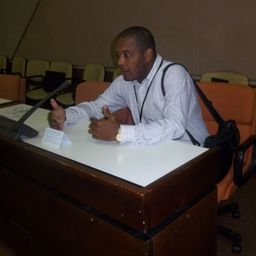
[ESP/ENG] Historia de vida / Tremendo pegador: José Gómez Mustelier
Nacido el 28 de enero de 1959, en los predios del central azucarero Colombia, en la provincia de Las Tunas, siempre se destacó por la fuerza de su pegada, y el respeto y autoridad que imponía en los cuadriláteros de todo el mundo. Sus inicios en el boxeo fueron con el entrenador Rolando Guerra en su natal Colombia.
En 1977 participó en su primer Torneo Playa Girón y no pudo tener un mejor debut. En la Ciudad Héroe llegó a la final por la medalla de oro nada menos que frente al consagrado Emilio Correa. Aunque no alcanzó el oro, fue llamado a integrar la preselección nacional, donde conoció al profesor Sarvelio Fuentes.
Ese mismo año participó en su primer Torneo Córdova Cardín, en Matanzas, y debutó con una impresionante victoria por RSC en el segundo asalto ante el guyanés Anthony Thomas. Luego venció 5-0 al santiaguero Juan Despaigne y en la final ganó cerradamente por veredicto de 3-2 sobre el pinareño Hermenegildo Báez.
Pocas veces perdió por RSC o fuera de combate. Una de esas ocasiones ocurrió durante las competencias de boxeo de la IV Espartaquiada de los Ejércitos Amigos.
En ese combate cometió un descuido defensivo imperdonable ante el soviético Leonid Shapornikov, que lo llevó a perder por KO. Este revés constituyó otro momento de aprendizaje que años después le serviría de experiencia, incluso ante el mismo adversario.
En 1978 el boxeo cubano tenía grandes compromisos internacionales, entre los más importantes los Juegos Centroamericanos y del Caribe de Medellín, Colombia, y el segundo Campeonato Mundial de Boxeo.
Gómez estaba dispuesto a representar al país en ambos torneos y quería demostrarlo en los dos torneos boxísticos más importantes del país: el nacional Playa Girón y el internacional Córdova Cardín. En ambos torneos aplastó literalmente a todos sus rivales y no dejó lugar a dudas; él era el hombre de la división de los 75 kg.
Participó en el segundo campeonato mundial, celebrado en Belgrado, antigua Yugoslavia donde se enfrentó a rivales muy calificados, entre otros el finlandés Tamuz Usivirta y el soviético Shapornikov, quien años antes había noqueado al cubano. En este torneo dio muestra de su valía y calidad al imponerse a todos los rivales, incluidos el soviético y el finlandés, a quien derrotó en la final.
A partir de ese momento tenía una sola idea fija en su memoria: alcanzar la medalla de oro en los Juegos Olímpicos de Moscú 1980. Para ello derrotó a todos sus rivales en los torneos más importantes en los que participó: Juegos Centroamericanos y del Caribe, Medellín, Colombia (1978); Juegos Panamericanos, San Juan, Puerto Rico (1979). En esta etapa previa a Moscú '80, ganó cinco topes bilaterales contra boxeadores de Estados Unidos.
Cuando llegó el momento esperado por él para cumplir su gran sueño olímpico, muchas incertidumbres rondaban la figura del campeón mundial de la división.
La causa fundamental fue un peligroso accidente automovilístico sufrido en la capital del país, que no le permitió llegar a este torneo en su mejor forma física.
La primera pelea fue contra un boxeador desconocido e inexperto, a quien derrotó por votación dividida de 3-2. Este resultado aumentó las incertidumbres existentes. En el segundo combate estuvo a punto de perder su sueño cuando un bixeador coreano le propinó un fortísimo golpe que lo puso en malas condiciones; pero el asiático cometió un grave error al ir a rematarlo y recibió un bombazo de Gómez que lo fulminó.
Aunque ganó su combate semifinal, tampoco convenció, a pesar de recibir el voto de todos los jueces. Ante estos antecedentes, la gran mayoría de los espectadores soviéticos daban como favorito al peleador local, Savchenko.
A pesar de todo, Gómez realizó en la final su mejor combate del torneo. La pelea comenzó con Savchenko golpeando fuerte y Gómez ripostando con mayor precisión, hasta el punto de propinarle un conteo de protección en el mismo primer asalto. Savchenko estaba al borde del fuera de combate cuando se cumplió el límite de los tres minutos. Con esta victoria, José Gómez Mustelier alcanzaba el gran sueño de su vida y se convertía en Campeón Olímpico.
En su trayectoria deportiva, Gómez atesoró todos los títulos otorgados por la Asociación Internacional de Boxeo Amateur y, junto a Teófilo Stevenson, es considerado como uno de los púgiles, a nivel mundial, con más fortaleza en su pegada.
Nota: He utilizado el traductor DeepL Translate.
ENGLISH
There are people destined to achieve great things in life, and our protagonist is one of them.
Born on January 28, 1959, on the grounds of the Colombia sugar mill in Las Tunas province, he always stood out for the power of his punch and the respect and authority he commanded in boxing rings around the world. His boxing beginnings were with coach Rolando Guerra in his native Colombia (town).
In 1977, he participated in his first Playa Girón Tournament and could not have had a better debut. In the Hero City (Cienfuegos), he reached the final for the gold medal, none other than against the renowned Emilio Correa. Although he did not win the gold, he was called up to join the national preselection team, where he met coach Sarvelio Fuentes.
That same year, he participated in his first Córdova Cardín Tournament in Matanzas and debuted with an impressive RSC victory in the second round against Guyanese boxer Anthony Thomas. He then defeated Santiaguan Juan Despaigne 5-0 and narrowly won the final 3-2 over Pinar del Río's Hermenegildo Báez.
He rarely lost by RSC or knockout. One of those occasions occurred during the boxing competitions of the 4th Spartakiad of the Friendly Armies.
In that fight, he made an unforgivable defensive lapse against the Soviet boxer Leonid Shaposhnikov, which led to a KO loss. This setback became another learning moment that years later would serve as experience, even against the same opponent.
In 1978, Cuban boxing had major international commitments, among the most important being the Central American and Caribbean Games in Medellín, Colombia, and the second World Boxing Championship.
Gómez was determined to represent the country in both tournaments and wanted to prove it in the two most important boxing tournaments in the country: the national Playa Girón and the international Córdova Cardín. In both tournaments, he literally crushed all his rivals and left no doubt; he was the man in the 75 kg division.
He participated in the second world championship, held in Belgrade, former Yugoslavia, where he faced highly qualified rivals, including the Finnish boxer Tamuz Usivirta and the Soviet boxer Shaposhnikov, who had knocked out the Cuban years earlier. In this tournament, he demonstrated his worth and quality by defeating all his rivals, including the Soviet and the Finnish boxers, whom he defeated in the final.
From that moment on, he had only one fixed idea in his mind: to win the gold medal at the 1980 Moscow Olympic Games. To this end, he defeated all his rivals in the most important tournaments he participated in: Central American and Caribbean Games, Medellín, Colombia (1978); Pan American Games, San Juan, Puerto Rico (1979). In this pre-Moscow '80 stage, he won five bilateral matches against boxers from the United States.
When the moment he had been waiting for to fulfill his great Olympic dream arrived, many uncertainties surrounded the figure of the world champion in the division.
The main cause was a dangerous car accident he suffered in the country's capital, which prevented him from arriving at this tournament in his best physical shape.
His first fight was against an unknown and inexperienced boxer, whom he defeated by a split decision of 3-2. This result increased the existing uncertainties. In the second fight, he almost lost his dream when a Korean boxer landed a very powerful blow that left him in bad shape; but the Asian made a serious mistake by going for the finish and received a bomb from Gómez that knocked him out.
Although he won his semifinal fight, he did not convince either, despite receiving the vote of all the judges. Given this background, the vast majority of Soviet spectators favored the local fighter, Savchenko.
Despite everything, Gómez delivered his best fight of the tournament in the final. The fight began with Savchenko hitting hard and Gómez countering with greater precision, to the point of scoring a standing eight-count against Savchenko in the very first round. Savchenko was on the verge of being knocked out when the three-minute limit was reached. With this victory, José Gómez Mustelier achieved the great dream of his life and became an Olympic Champion.
In his sports career, Gómez amassed all the titles awarded by the AIBA and, along with Teófilo Stevenson, is considered one of the boxers worldwide with the most powerful punch.
Note: I used the DeepL Translate translator.
Leave [ESP/ENG] Historia de vida / Tremendo pegador: José Gómez Mustelier to:

Best Posts From Antonio Manuel Napoles Rivero
We have not curated any of tonyes's posts yet. But you can encourage our curation team to review posts by visiting them regularly and by referring other readers. Because we give priority to frequently read content.
More Posts From Antonio Manuel Napoles Rivero
- My second encounter with the Yumurí River Canyon
- [ESP/ENG] El silencio como lenguaje en las relaciones humanas /Silence as a language in human relationships
- [ESP/ENG] ¡Histórico doblete de Cuba en hockey sobre césped!
- [ENG/ESP] The beauties of Punta Alegre (AN) / Las bellezas de Punta Alegre (AN)
- [ESP/ENG] Cuando dejé de ser el protagonista de la historia de todos
- [ESP/ENG] Papelazo / disgraceful performance
- [ESP/ENG] El impacto de lo que no dices / The impact of what you don't say
- [ENG/ESP] Back to my roots / De vuelta a mi raíz
- [ENG/ESP] Geomorfología fluvial y patrimonio natural de las cascadas del Escambray
- Week 315 | Parenting doesn't make you good or bad